Flight Free Schools
A project by Flight Free UK to reduce or remove air travel for school trips

What is it?
Flight Free Schools is a scheme that helps schools reduce or remove the use of air travel for school trips. Reducing or removing air travel is an easy way of bringing school-wide emissions down and reaching climate targets, and can benefit student learning as well as environmental health.
Schools sign up for one year at a time, and make a pledge appropriate to the school. They work with Flight Free UK to fulfil the pledge, and receive a certificate to show their involvement.
There is no cost to the school, and the benefits can be enormous!
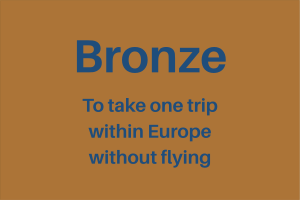
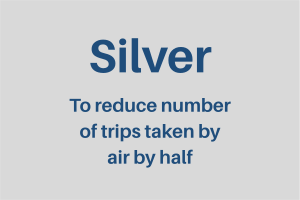
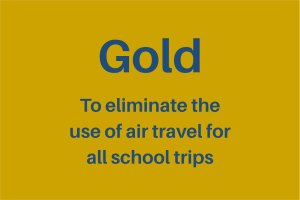
Example pledges:
Why do it?
The Department for Education says that schools must have a Climate Action Plan in place, and many schools are already taking steps to reduce emissions. Removing flights is one of the quickest, cheapest and most effective way of reducing emissions.
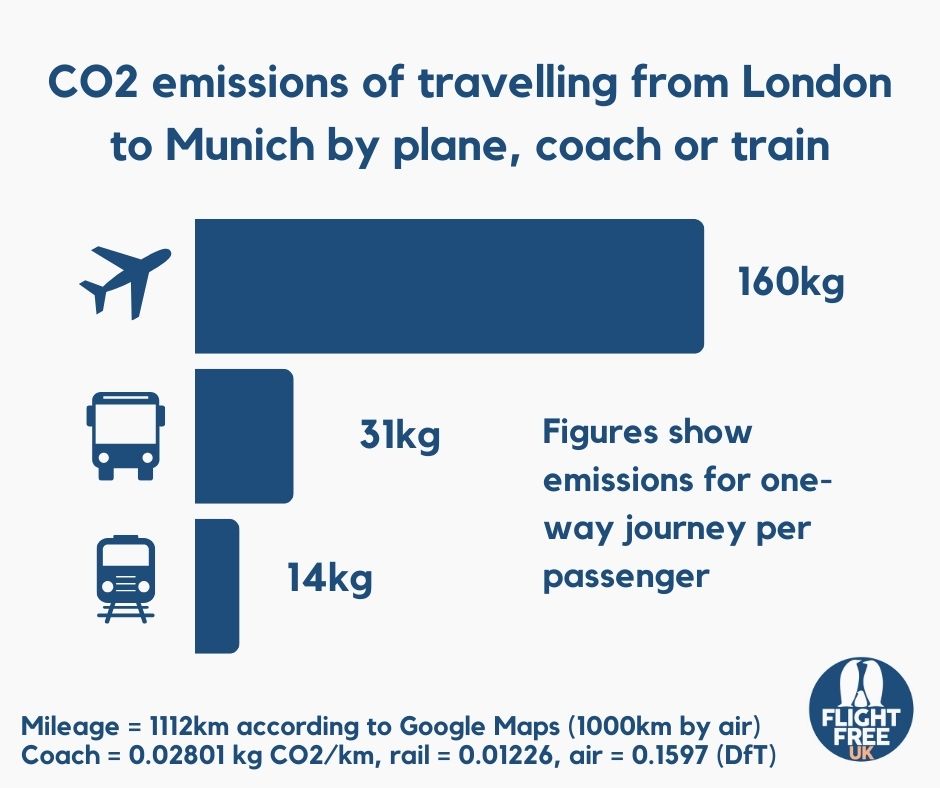
Emissions from school trip flights can be many times higher than emissions from other school activities, so reducing or removing flights can have an immediate and significant impact on school carbon reduction targets.

Flight-free trips are more inclusive, as trips involving long-haul flights might be inaccessible to students from disadvantaged backgrounds. Focussing on local trips will help improve access for all.
Removing flights from trips helps to model low-carbon behaviour and inspire climate-friendly choices later in life, as flying for school trips normalises air travel, potentially creating a new generation of frequent flyers. This will make it harder to build the low-carbon society that is needed to address the climate crisis.
How to go on trips without flying
Our recommendation is coach travel. Most destinations within Europe are easily accessible from all parts of the UK by coach, and coach travel is usually the cheapest and most logistically easy option.
Taking the train is also an option, but many schools prefer the coach as it’s cheaper and the logistics are more straightforward, with no interchanges.
Coach vs flight
A smoother experience for teachers: pupils board the coach at the school, and disembark at the destination. There’s no need for airport transfers or for waiting around in a departure lounge. You can make a relationship with your driver/s, who you keep throughout the full trip.
Cheaper: with air travel, the price rises the more seats you book. With coach travel, you pay a single fee for the coach, meaning that a full coach is a lot cheaper per student than flying.
There’s no limit on the amount of baggage everyone can take, and less chance of it being damaged or lost in transit.
The time on the ferry gives a perfect break for pupils to walk around, have food and entertain themselves, within an enclosed space.
Coach travel takes longer, but it’s easy. Students are remarkably resilient even on 24-hour journeys (teachers perhaps less so!).
Schools are travelling by coach to destinations across Europe, even from the north of England and Scotland.
Suggested destinations
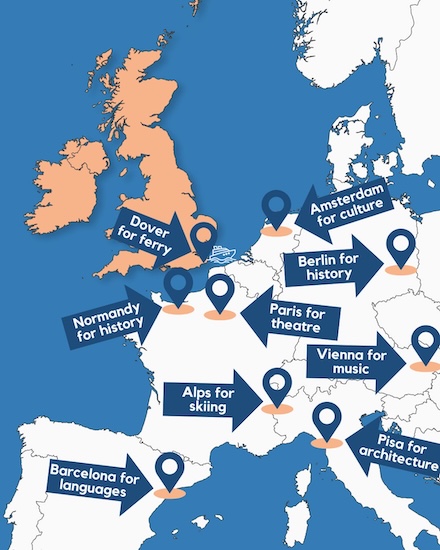
- Paris for theatre
- Normandy for history
- Amsterdam for culture
- Alps for skiing
- Berlin for history
- Barcelona for languages
- Pisa for architecture
- Vienna for music
Case studies
Hills Road Sixth Form College, Cambridge, Gold level (no flights).
The college stopped taking flights in 2020 because it was the quickest and most effective way to reach their carbon reduction targets. An analysis of the college-wide carbon footprint showed that flights for trips made up 11% of the college’s overall emissions, which is more than electricity use or gas use over the course of a year.
The PE department used to fly to Boston, Massachusetts. They now go to Manchester, which the Head of PE says aligns more closely with the curriculum. The Art department used to fly to Berlin and Amsterdam, and they now go to Paris by train, or take the coach to Amsterdam. The French department used to fly to Marseilles, and now they take the train to Paris. The Spanish department used to fly to Santander, but they now take the coach.
Most departments have adapted well, and found close-to-home locations that work well for their trips. Many have found that taking the coach is simpler and less stressful than flying.
Replacing long-haul trips with short-haul coach travel has enabled more students to take part, especially those from low-income backgrounds.
It has been a significant challenge for the Spanish department, because getting to Santander requires a 24 hour coach journey, which is tiring for the staff and the students, although they mostly find it enjoyable.
Year 13 student Kikamma was on the Spanish exchange trip and said, "It’s really nice to be able to go to Spain but to be able to do it in a way that’s environmentally conscious. It’s so important that we do that to have a world for ourselves and for generations to come as well. I think the least we can do is choose not to fly as much as possible."
What support is available?
Flight Free UK will help, advise and support the school throughout the project.
At the start of the project, the school will:
- assign a member of staff (usually the Sustainability Lead) to be the project liaison
- arrange an initial meeting with the SLT (online or in-person)
- provide information about the number and type of trips currently taken to establish baseline data
Flight Free UK will work with departmental staff to help gather data, plan trips, and share the scheme with parents and the wider school community.
With Flight Free UK’s help, the school will carry out a survey at the end of the year among students, staff and parents to gather data on the outcomes and experiences of participants.
For more information or to join the scheme,
email info@flightfree.co.uk