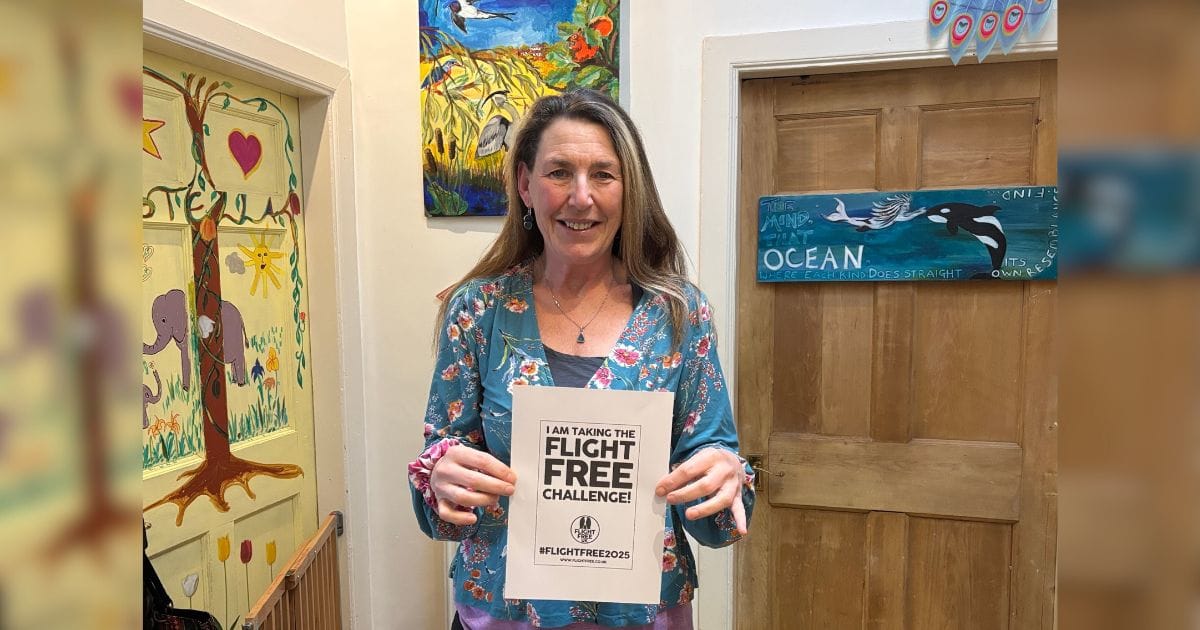
As a musician, I’ve always struggled to justify my career whilst there are so many crises happening around the world.
Surely it would be more helpful to work in a sector that directly addresses the challenges we’re facing?
But then the pandemic happened, and we realised how undervalued the arts are. Live music can provide both escapism and connection – two things that we deeply need, and that were missing during those years.
I remember how it felt to attend the first concert after restrictions were lifted. It was magical, and reminded me why I do what I do, and that it does have its place in today’s world.
However, there is another thing about my career that is problematic: touring. In my industry there is an expectation to fly to gigs abroad (or even within the UK). Saying no to flying often means one of two things: lose money because covering the train fares wipes out any income, or lose the work to somebody willing to fly. I quickly realised that just quietly saying no isn’t sustainable, both as a career move and with regards to the environment.
In my industry there is an expectation to fly. Just quietly saying no isn’t sustainable.
This is when I had a brainwave: I could undertake a tour by bike! It would not only reduce my own touring emissions, it would enable me to work abroad while also inspiring musicians and audiences about the possibilities of greener touring. I’d previously cycled to play at a concert/festival in Germany, so I knew it was possible. Finally, I had found a way for my career to match up with my need to do something meaningful.
I am a viola da gamba player, and touring with my instrument is more complicated than if I were, say, a flautist. The viola da gamba (also known as a ‘viol’) is an instrument with six or seven strings, and it’s played with a bow and held with the legs (hence ‘da gamba’). There are several sizes of viol, with the smallest being roughly violin size, and the bass viol about the same size as a modern cello.
I decided to tour with my bass viol for maximum visual impact – it’s hard to miss! Carrying it is, however, a little challenging. I used an AirPannier and a couple of bungees to attach it to one side of the rear pannier rack, which balanced well with my other luggage and held securely.
The original plan was to head to the nearest coast and straight overseas, but the more I looked at the map, the more places I noticed within the UK worth visiting. I started to wonder whether I’d thought about touring completely wrong. It’s so easy to miss what’s closer to home. Sometimes it can feel like we’re in some far flung place simply by turning left when the road sign nudges you to follow the crowd to the right. Overseas travel could wait.
The more I looked at the map, the more places I noticed within the UK worth visiting. It’s so easy to miss what’s closer to home.
It took around six months to plan the tour which was titled Good Again?, inspired by a piece of music by the Scottish composer Tobias Hume, and posing the question of how we can take actions in our personal and professional lives that turn the clock back on the climate crisis. Then it was a case of liaising with the venues, listing all the concerts online wherever possible, making posters, emailing news outlets, radio, etc. This continued throughout the tour with lots of late night admin from my tent.
In ten weeks on the road, I cycled over 4,500km and gave 31 performances (plus a few extra, if you include playing to ponies in Yorkshire, cows in Northumberland, and sheep in the Lake District), choosing to play in the in-between places: small, often community-run venues, with audiences made up mostly of locals who’d never heard a viola da gamba before.
Playing in these spaces felt very different to the typical concert setting I’m used to. There was no invisible barrier between the audience and me. Sometimes there wasn’t space: at Bitterne Station Community Hub, for example, I could have reached out and touched the front row. It was sold out and, in the height of a heatwave at 36 degrees, this was by far the hottest gig I’ve ever played.
The tour included the Outer Hebrides, Orkney and Shetland, and while each of these island groups have airports, I definitely wasn’t going to fly. Of course the environmental reasons against doing so are enough, but it would have been impossible to take my bike on a plane. Bikes and ferries, now they go well together.
Ferries are also great places to meet interesting characters. I met a lovely bunch of cyclists on the ferry from Oban to Barra, all of us planning to cycle up the Hebridean Way with various goals along the way. Several of them actually came to my performances. I can’t say whether this was out of interest or purely to seek shelter. The weather was… rough.
In any case, these friendly faces popped up numerous times throughout the islands and I was never alone for long. This was in part due to the locals, many of whom offered to transport my instrument (which I politely refused) or offered dinner and a bed for the night (which I politely accepted). There were enough nights of camping still to come.
Deciding to tour with my bass viol paid off because there were several performances where audience members had come after seeing me and my curiously large instrument on the road. This included a group of ladies I met on Barra, who came to my gig in Bristol over a month later, along with a couple I’d met on Yell; a lady I’d met in the Viking longhouse on Unst, Shetland who came to a performance in London; and Georgia, who’d cycled from Shrewsbury to Llanidloes where I performed at The Hanging Gardens, and then towards Abergavenny with me… the list goes on! Cycling is such a great leveller.
Camping is, too. For example, the vast majority of the audience in Durness came from the campsite I was at. It surprised me many times how effective word of mouth is in rural areas. Publicising the events was a challenge whilst on the road, yet in the places where I expected a meagre turnout, it was full.
I did eventually make it to the continent: after the Good Again? UK tour, I spent a month pedalling around France, this time with no plan, no fixed performances and therefore a lot less admin. Each night, I’d get the map out and choose where to aim for the following day, making a note of where I’d pass that might have a gamba-friendly spot to play.
If it wasn’t raining (which it did a lot), I’d plonk myself on a bench outside a shop, in a square, on a campsite, those little huts on towpaths etc. I played in an orchard to an audience of donkeys and was invited into a couple of cafes and a hall to play. I don’t speak more than a handful of words of French, so communication was pretty limited in rural areas, but people often gathered around and I’d try to explain why I was travelling this way and playing this music.
One special mention for this part of the trip: crossing the Channel from Dover to Boulogne-sur-Mer with the Saillink ferry. It’s a sailing catamaran designed to take foot passengers and cyclists across the channel, avoiding the often unpleasant experience of going by conventional ferry. The crossing felt like a holiday in itself. I loved every minute of it. Taking my bike and gamba onboard was really easy, and the team were so friendly. I’d recommend it to anyone travelling by foot or bike.
Now I’m back home, I continue to cycle to as many gigs as possible, and will do so for as long as possible. As a result of the tour, I’ve been invited to speak to students at universities and conservatoires, and hopefully inspire the next generation to use their creative power for good.
You can find out more about Sarah at her website: sarahsmallviol.crd.co and Instagram: @smallsarah